This is a top 5 takeaways video summary of The Little Book That Beats The Market by Joel Greenblatt, the famous inventor of the magic formula.
這是一段關於《擊敗市場的小書》的前五大收穫影片摘要,作者是著名的魔法公式發明者喬爾·格林布拉特。
00:12
What should you be doing with all your hard earned money?
你應該如何處理你辛苦賺來的錢呢?
00:16
You could put it under a mattress, lend it to a bank, lend it to a company, or you could invest it in a company, in the stock market.
你可以把它放在床墊下、借給銀行、借給公司,或者投資於股市中的某家公司。
00:29
This is probably the best alternative.
這可能是最好的選擇。
00:32
The problem is just that most people have no business investing in individual stocks on their own.
問題在於,大多數人其實不適合自己投資個股。
00:38
Or, as Joel Greenblatt puts it, choosing individual stocks without any idea of what you're looking for is like running through a dynamite factory with a burning match.
It's all too early in the video for me to reveal it, but let's just say that it rhymes with the the magic formula.
現在說還太早,但可以告訴你,它與魔法公式押韻。
01:08
Takeaway number one, the madness of the markets.
第一個收穫:市場的瘋狂。
01:12
Think of a company, any company.
想一家公司,任何公司。
01:16
No, that's a good one.
不,這是個好例子。
01:19
Yep, Amazon it is.
好的,就說亞馬遜吧。
01:22
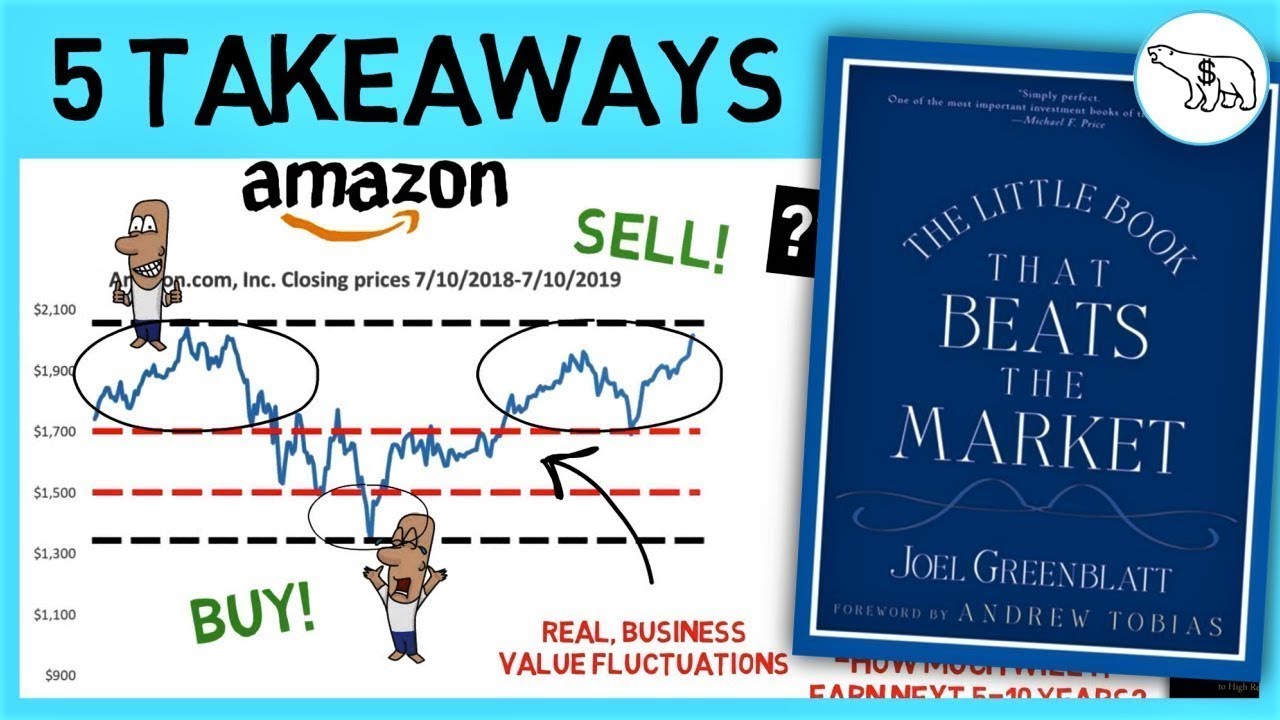
During the last year, you could have bought Amazon for as low as $1,377 and as high as $2,012, a price difference of about 50%.
在過去一年裡,你可以用最低1,377美元和最高2,012美元買入亞馬遜股票,價差約為50%。
01:34
Not just that, but the value of the whole company bounced from about a trillion dollars down to approximately $650 billion and then back up to a trillion dollars again.
不僅如此,整個公司的價值從約1萬億美元下跌至約6,500億美元,然後又回升到1萬億美元。
01:47
Well, what's your point?
那你想說什麼?
01:49
You may ask.
你可能會問。
01:50
My point is that Amazon, the business, didn't shift in value that quickly.
我的意思是,亞馬遜這家企業的價值並沒有那麼快地變化。
01:56
The market is simply overreacting to the information that it is presented with.
市場只是對所呈現的資訊過度反應。
02:02
But this all may just be a fluke.
但這一切可能只是巧合。
02:05
Maybe you, when I asked you to pick a company, happen to pick an extremely volatile one.
也許當我叫你選一家公司時,你剛好選了一家極度波動的公司。
02:10
Alright then, I'll give you another shot.
好的,那我再給你一次機會。
02:13
Think of a company.
想一家公司。
02:17
What was that?
你說什麼?
02:19
Okay, sure, yeah, a gap should do.
好的,沒問題,Gap 就好。
02:23
During the last year, you could have bought Gap, America's largest fashion retailer for as little as $18 per share.
在過去一年裡,你可以用每股 18 美元的價格買入 Gap,這是美國最大的時尚零售商。
02:31
Actually, that's the current price and as high as $31 per share.
其實,這是目前的價格,而最高曾達到每股 31 美元。
02:36
That's an even bigger difference, more than 70%.
這差距更大,超過了 70%。
02:40
Do you think that Gap sold 70% more clothes 10 months ago than they do today?
你認為 Gap 在 10 個月前賣出的衣服比現在多 70% 嗎?
02:46
No.
不是。
02:47
Clearly, at times, the market doesn't know what it is doing.
顯然,有時市場並不知道自己在做什麼。
02:56
Takeaway number two.
第二個重點。
02:58
How much is a business worth?
一家企業值多少錢?
03:00
When looking at these fluctuations, it's fairly simple to tell that the market isn't always efficient.
在看這些波動時,很容易看出市場並非總是有效的。
03:08
Sometimes greed is ruling and the prices are too high.
有時貪婪主導,價格過高。
03:11
And at other times, fear is ruling and the prices are too low.
而有時恐懼主導,價格過低。
03:16
Suppose that the value of Amazon as a business fluctuated between $1,500 and $1,700 during the last year, while the prices fluctuated between $1,377 and $2,012.
If you could state this with any kind of certainty, becoming rich trading Amazon stocks would be a really simple task.
如果你能以任何確定性陳述這一點,那麼通過交易亞馬遜股票致富將是一件非常簡單的事。
03:40
Just buy it whenever the price goes way below $1,500 and sell it whenever it goes way above $1,700.
只要在價格遠低於 1,500 美元時買入,並在價格遠高於 1,700 美元時賣出。
03:49
The problem is, it is not that simple.
問題是,這並沒有那麼簡單。
03:53
Let's take an example.
讓我們舉個例子。
03:55
One of your friends owns a shop called the Swedish merchant.
你的一位朋友擁有一家名為「瑞典商人」的商店。
04:00
It sells only Swedish stuff.
這家商店只賣瑞典商品。
04:03
The shop made a profit of $100,000 last year.
這家商店去年賺了10萬美元的利潤。
04:08
How much would you be willing to pay for it, knowing this?
知道這一點,你願意為它付多少錢?
04:14
Well, your guess is as good as mine, as long as you guessed somewhere between $500,000 and $2,000.
你的猜測和我的一樣好,只要你的猜測在50萬美元到2,000美元之間。
04:22
In the stock market, you're typically provided with more information than this before you ask to determine the price of a business.
在股票市場中,通常在你要求確定一家企業的價格之前,會提供比這更多的資訊。
04:29
But the difficulties are the same, nonetheless.
但困難仍然是相同的。
04:31
Firstly, $100,000 is just what the Swedish merchant earned last year.
首先,$100,000只是「瑞典商人」去年賺的錢。
04:38
We must determine if it, after our purchase, will be able to generate more or less than that in the coming year.
我們必須確定,在我們購買後,它在未來一年是否能賺得比這更多或更少。
04:45
Secondly, we must decide how confident we are in that prediction.
其次,我們必須決定對這個預測有多大的信心。
04:49
And thirdly, it's not just about the next year.
再者,這不僅僅是關於明年。
04:52
Potentially, we could own the Swedish merchant for a very long time.
潛在地,我們可能會擁有「瑞典商人」很長一段時間。
04:55
So we have to estimate, okay, guess how much the business will earn 5 to 10 years from now as well, in order to be able to set a definite price tag on it.
因此,我們必須估計,好的,猜測這家企業在5到10年後能賺多少錢,以便能為它設定一個明確的價格標籤。
05:05
Head over to my summary of the Dondo Investor for more on this.
到我的「Dondo Investor」總結中查看更多相關內容。
05:14
Takeaway number 3, PE and ROA.
第三個要點,PE和ROA。
05:19
So far, we've concluded that stocks sometimes sell at a discount from their underlying value, but that it's very difficult to decide when that is happening.
到目前為止,我們得出的結論是,股票有時會以低於其內在價值的折扣出售,但很難決定何時會發生這種情況。
05:30
So, is it hopeless?
所以,這是否沒有希望?
05:33
No, obviously not.
不,顯然不是。
05:36
Because otherwise, I would be wasting your time, which is something I would never do.
否則,我就浪費你的時間,這是我永遠不會做的事。
05:41
Unless, of course, I'd make a pointless feeling clip.
除非,當然,我做了一個無意義的感覺剪輯。
05:45
Let me present the Swedish merchant's most fearsome competitor, just broccoli.
讓我介紹瑞典商人的最可怕競爭對手,只是西蘭花。
05:51
The Swedish merchant earns $100,000 per year, like I presented before, while just broccoli earns $50,000.
瑞典商人每年賺取10萬美元,就像我之前介紹的,而只是西蘭花賺取5萬美元。
06:01
The price of the businesses is $1 million each.
這些企業的價格為每家100萬美元。
06:05
Which one would you rather buy? Everything else equal?
在其他條件相同的情況下,你更願意買哪一個?
06:11
You would buy the Swedish merchant, of course.
當然,你會買瑞典商人。
06:15
Here, you only pay $10 for every $1 in earnings.
這裡,你只需要為每1美元的收益支付10美元。
06:18
In just broccoli's case, you pay $20 for every $1 in earnings.
在只是西蘭花的情況下,你需要為每1美元的收益支付20美元。
06:24
The Swedish merchant would pay your initial investment back in 10 years, compared to just broccoli's 20 years.
瑞典商人將在10年內償還你的初始投資,而只是西蘭花則需要20年。
06:31
In the stock market, the most common way of measuring this is through the so-called price to earnings or PE ratio.
在股票市場中,最常見的衡量方法是通過所謂的市盈率或PE比率。
06:39
The PE ratio is calculated by taking a business current price and dividing it by its earnings.
PE比率是通過取企業的當前價格並除以其收益來計算的。
06:46
The PE of the Swedish merchant is 10, and that of just broccoli is 20.
瑞典商人的PE是10,而只是西蘭花的PE是20。
06:53
This is the first point of this takeaway.
這是這個要點的第一點。
06:56
You would rather own a business with a low PE than a high one.
你更願意擁有一個PE較低的企業,而不是PE較高的企業。
07:03
Simultaneously, price is not everything.
同時,價格並不是一切。
07:06
Even buying at a low PE can result in a disastrous investment.
即使以低PE購買也可能導致一個災難性的投資。
07:11
You must also make sure that you buy a good business.
你還必須確保你購買的是一個好的企業。
07:14
This is where return on assets, or ROA, comes into play.
這就是資產回報率或ROA發揮作用的地方。
07:20
Let's say that building that store of the Swedish merchant costs $500,000, and the store of just broccoli also costs $500,000.
假設建造瑞典商人的商店成本為50萬美元,而只是西蘭花的商店也成本為50萬美元。
07:30
Everything else equal would you rather invest in the company that can build stores with $100,000 in profits for $500,000, or the company that can build stores with $50,000 in profits for $500,000.
Once again, you would prefer the Swedish merchant's business.
你會再次偏好瑞典商人的生意。
07:53
This ratio is referred to as return on assets, or ROA.
這個比率被稱為資產報酬率,或ROA。
07:58
The higher, the better.
越高越好。
08:01
It says something about the quality of the business, and with comparable companies, it can often show you which of the companies that possess the best moat, something that Warren Buffett loves to see in his investments.
For more on important ratios to consider when making an investment, please see my summary of the interpretation of financial statements by Benjamin Graham.
關於投資時要考慮的重要比率,請參閱我對本傑明·格雷厄姆《財務報表解讀》的總結。
08:29
Takeaway number four, the magic formula.
第四點收穫,魔法公式。
08:33
If you stick to buying good companies, or in other words, those with a high ROA, while buying these companies at low prices, or in other words, when their PE ratios are low, you will end up buying underpriced businesses.
Joelle Greenblatt even constructed a system that will do just that for you, which she calls the magic formula.
喬爾·格林布拉特甚至構建了一個系統,為你做到這一點,她稱之為魔法公式。
08:58
It's simply ranking companies according to their combined score in these two regards, the quality and the price of the business.
它只是根據公司在這兩方面的綜合得分進行排名,即企業的品質和價格。
09:07
Intuitively, it does make a lot of sense.
直觀地看,這很合理。
09:11
And when backtesting it, it does make a lot of financial sense as well.
而回測時,它在財務上也很合理。
09:16
During the 17 years period that Joelle Greenblatt evaluated the magic formula, it outperformed the overall market by about 18%, returning 30.8% per year rather than 12.3% per year.
With such a return, $10,000 turned into almost a million in 17 years, as compared to the market's more modest increase to just $70,000.
以這樣的回報率,$10,000在17年內幾乎變成了100萬美元,而市場僅增長到$70,000。
09:44
Some of the companies that you'll invest in using this formula will turn out to be crappy investments, but the important thing is that, on average, it will help you to find true bargains.
使用這個公式投資的一些公司可能會變成爛投資,但重要的是,平均來看,它能幫助你找到真正的便宜貨。
09:57
If you're not impressed by the results yet, consider what happened when Joelle Greenblatt divided companies into 10 different groups, ranking them with the formula.
如果你對結果還不滿意,看看喬爾·格林布拉特將公司分成10個不同組別,並用公式排名後的結果。
10:07
As you can see, it's quite a good predictor.
如你所見,這是一個很好的預測器。
10:11
The best group performed better than the second best, and the second best performed better than the third best and so on.
最佳組別的表現優於第二佳組別,第二佳組別優於第三佳組別,依此類推。
10:17
Crazy!
太神奇了!
10:23
Takeaway number five, step-by-step instructions.
第五點收穫,逐步指南。
10:28
Here comes a step-by-step instruction on how to invest using the magic formula.
以下是使用魔法公式進行投資的逐步指南。
10:33
But just remember, the ideas and strategies presented on this channel should never be used without first assessing your own personal and financial situation, or without consulting a financial professional.
但請記住,本頻道提出的理念和策略在使用前,務必先評估您的個人和財務狀況,或諮詢專業財務顧問。
10:41
Please remember that past performance may not be indicative of future results.
請記住,過去的表現可能無法預測未來的結果。
10:44
1. Go to magicformulainvesting.com 2. Choose a company size.
1. 進入 magicformulainvesting.com 2. 選擇公司規模。
10:53
50 million or bigger should do.
5000 萬美元或以上為宜。
10:56
3. Follow the instructions on the site to get a list of top-ranked magic formula companies.
3. 依照網站指示取得魔法公式排名前列的公司清單。
11:03
4. Buy between 5 and 7 of these companies.
4. 從中選購 5 至 7 家公司的股票。
11:07
Spend 20 to 33% of the capital that you intend to invest.
投入您計劃投資資金的 20% 至 33%。
11:11
5. Repeat step four every two to three months, until all your capital is invested.
5. 每兩至三個月重複步驟四,直到全部資金投入為止。
11:20
This should result in a portfolio of about 20 to 30 stocks.
這應該會形成一個約 20 至 30 檔股票的投資組合。
11:25
6. Sell the stocks after holding them for a year.
6. 持有一年後賣出這些股票。
11:29
4 tax purposes hold the winners a few days longer than a year and the losers a few days shorter.
為了稅務目的,盈利股票持有超過一年幾天,虧損股票則持有不足一年幾天。
11:36
Repeat step four with a money from your selling.
用賣出股票的資金重複步驟四。
11:40
7. Continue the process for many years.
7. 多年持續這個過程。
11:44
If you are like me and you find investing to be a very challenging and stimulating interest that you don't want to throw away for some automatic formula, with a name that makes it sound like a scam by the way, you could use it for screening purposes only.