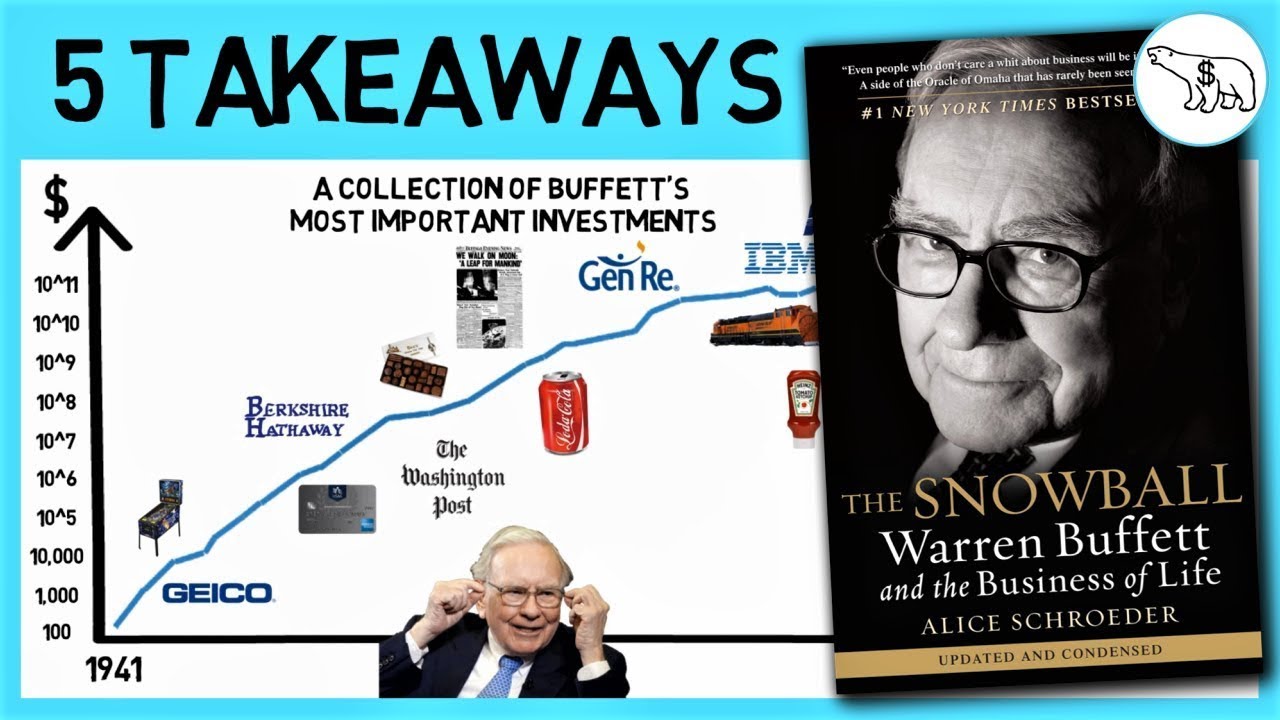
Warren Buffett is arguably the most successful investor of all time.
沃倫·巴菲特可說是有史以來最成功的投資者。
00:03
He has been averaging approximately a 20% growth of his capital per year, which has turned his small fortune of a thousand bucks in the early 1940s into quite an outstanding one of 86 billion as of 2018. In 2007 he became the richest man in the world for the first time,
and lately he's been having a back and forth with the likes of Bill Gates and Jeff Bezos.
近年來,他與比爾·蓋茨和傑夫·貝佐斯等人在財富榜上你來我往。
00:27
He's complete focus on investing can't be overstated. He always tried to save a buck in order to grow his capital faster, not interested in real estate, art, cars or any other tokens of wealth.
He still lives in the same old house which he did 50 years ago. During his honeymoon together with a young Susie Buffett, he traveled the US with a car stuffed with annual reports and Moody's manuals. He basically never stopped studying, ever. This is a video presenting the top five
takeaways of The Snowball: Warren Buffett and the Business of Life, written by Alice Schroeder.
該書由艾麗絲·施羅德撰寫。
01:04
This is the Swedish investor. Leading up to this biography, Buffett told Alice Schroeder, “Whenever my version is different from somebody else's, use the less flattering one.” In other words, not just the greatest investor of all time, but humble too. Let's get started with the takeaways.
Takeaway number one, the power of compounding income. Imagine that you recently started a new job.
第一個收穫,複利收入的力量。想像你最近開始了一份新工作。
01:32
During your first day, you work for eight hours and at the end of the day, your manager gives you a hundred bucks. The next day, you go back and you get ready for another eight hours of labor.
在第一天,你工作了八小時,在一天結束時,你的經理給了你100美元。第二天,你回去準備再工作八小時。
01:43
After seven hours and fifty minutes, your manager goes over to you, gives you a hundred dollars, and asks you to leave for the day. You're slightly confused, but don't complain about being able to quit ten minutes earlier. On day three, the procedure is repeated. Only this time, your manager gives
you a hundred bucks after seven hours and forty minutes. On day seven, when you manage your hands over your salary after only seven hours, you feel that you must ask what all this is about.
100美元。在第七天,當你在只有七小時後拿到工資時,你覺得必須問這是怎麼回事。
02:13
Why do you keep earning the same amount, but with less effort?
為什麼你一直賺相同的錢,但付出的努力卻越來越少?
02:17
Your manager simply gives you the following explanation: “Because you worked yesterday.” This example illustrates the power of compounding income. Money comes easier and easier the more you have of it, or as in our example, the more that you've worked previously. Warren Buffett understood
the importance of this at an early age. When he was presented with the book, 1,000 Ways to Make a Thousand Dollars, he was fascinated by one of the business ideas of the book, which was to buy weighing machines. You get paid by taking out a small fee every time someone wanted to use the
在這個過程中,他還發現了資本的奇蹟,即為其所有者工作的錢。
02:53
machine. Once you've gained enough money from weighing people with the first scale, you can now buy a second one. And earning money for the third one will go twice as fast. Warren Buffett used this approach early in his life, but the business consisted of pinball machines, not weighing machines.
He used the power of compounding income to his advantage, informing his first investing partnership, Buffett Associates. The deal was that he would gain half the upside, above a 4% gain, but pay a quarter of the downside to his partners. I have a hard time
seeing the fund managers of Wall Street expose themselves to such a risk of losing capital, but in Buffett's case, this was a calculated risk that accelerated his compounding even further.
By turning his company Berkshire Hathaway into an insurance company, Buffett has been using compounding to his advantage for many years now. You see, insurance premiums are always paid before the actual claims might come, which gives Buffett plenty of time to compound the money before an eventual payout. According to the saying,
if someone dropped a dollar, the average billionaire wouldn't bother picking it up, because the money gained from doing so is less than what he usually earns during such a time frame.
Warren, on the other hand, would gladly pick it up and state, “This is the start of my next billion.” That's the power of compounding.
而華倫卻會高興地撿起它並說:「這是我下一個十億的開始。」這就是複利的力量。
04:28
Takeaway number two, be very skeptical of new paradigms. New paradigm? It's like new sex, there just isn't any such thing. In 1999, just before the dot-com bubble went burst,
people spoke about a new paradigm when referring to the stock market. Many expected returns averaging 20% per year, and they thought that Buffett was crazy who didn't want to buy the hyped up internet stocks. Buffett was very skeptical, and explained that there are only three cases in
which high valuations like these ones could be motivated. One, interest rates are low and will continue to be so, or decline even further. Two, the share of the economy that goes to investors increases, in other words employers and the government get less.
Three, the economy starts to grow faster. He added that during the current circumstances, this was wishful thinking. The market is a voting machine in the short run and a weighing machine in the long run. There's no literacy test that leads to voting qualification,
which the market proves over and over again. But eventually, weight will count.
市場一再證明了這一點。但最終,重量會起作用。
05:51
Ultimately, the value of the stock market can only reflect the output of the economy.
最終,股市的價值只能反映經濟的產出。
05:57
Between 1964 and 1981, the Dow Jones industrial average stood still. At the same time though, the economy grew 5-fold. Why would investors pay the same price for something that generates 5 times the money? Well, simply because they thought that the rules of the game had changed
in 1964, and they paid a high price for thinking so. Herd mentality makes it easier said than done to be skeptical when we enter into bubble-like valuations. It's simpler to go through life as the echo, but only until the other guy plays a wrong note. You are neither right nor wrong
because people agree with you. You are right because your facts and reasoning are right.
你是正確的,因為你的事實和推理是正確的。
06:42
During times of wacky valuations, it helps to be guided by an inner scorecard rather than an outer scorecard. Consider this. Would you rather be the world's greatest lover but have everyone think that you're the world's worst lover? Or would you rather be the world's worst lover
but have everyone think that you're the world's greatest? If you would pick the previous option rather than the latter one, you are guided by an inner scorecard, which is very helpful in resisting to participate in the madness that the market sometimes displays.
Takeaway number three. Stay within your circle of competence.
第三個重點。堅守自己的能力範圍。
07:22
According to the story, a man was able to corner the market of shoe buttons, a very small and niche market, but he had all of it. Once he had accomplished this, he imagined himself as the expert of basically everything. While among his friends, he always knew best whether they were discussing
relationships, lovemaking, health or any other topic for that matter. Because of his expertise in one area, he thought he was a master of everything. Warren Buffett and Charlie Munger, his right hand man, referred to this as the shoe button complex. Buffett attributes much
of his success to the fact that he was able to avoid this and instead stay within his circle of competence: money, business and his own life. For instance, Buffett could have pursued his grandfather's dream of becoming an author but did not. Luckily, perhaps.
Within the field of investing, this is especially important. Buffett explained it like this: “We will not go into a business where technology, which is way over my head, is crucial to the investment decision. I know about as much about semiconductors or integrated
circuits as I do of the mating habits of the Shrasasak.” You are investing in a business, not a stock. Remember this well and see to it that you understand what kind of company you are actually buying. This could mean that you want to focus on industries aligned with your education.
For example, a medical student might want to invest in healthcare and pharma stocks, while an electrical engineer might want to focus on the energy sector.
例如,一個醫學生可能希望投資醫療保健和製藥股,而一個電氣工程師可能希望專注於能源行業。
09:05
This could also mean that you want to invest more of your money in your domestic market or companies exposed to your domestic market as you understand the business environment there better. For example, I focus on the Swedish market primarily.
Takeaway number four, use a margin of safety. Let's pretend that you're a construction engineer.
第四個重點,使用安全邊際。假設你是一位建築工程師。
09:29
You've been assigned with a task to build a bridge. The bridge is a very complex one, especially the calculations regarding the carrying capacity. You've been told that the trucks passing your bridge sometimes will weigh as much as 40 tons. Will you build a bridge so
that your calculations say that it supports 41 tons or 60 tons? If you picked 41 tons, this could be a possible scenario. You made a small mistake in your calculations so your bridge could only carry 38 tons in reality. Now this really heavy truck tries to drive across it.
Not so nice there. Sure, this could happen if you tried to build one which supports 60 tons as well, but the risk is reduced. Let's face it, our estimations when trying to predict the future of a stock are often… wrong. Therefore, we need plenty of room for error, a margin of safety.
If you think that a stock is worth $50, you don't buy it if it also costs $50 in the market.
如果你認為一支股票值50美元,你不會在市場上也以50美元的價格買入它。
10:41
In this situation, you might want to wait until the stock costs $40 instead, assuming that you still think its value remains the same at that point, of course.
Warren Buffett understood this early, thanks to his teachers Benjamin Graham and David Dodd.
華倫·巴菲特很早就理解了這一點,這要感謝他的老師本傑明·格雷厄姆和大衛·多德。
10:55
The margin of safety helps so that your profits from good decisions are not wiped out by the losses of your errors. A certain category of stocks that fulfills the margin of safety, which Buffett liked to invest in during his early career, are the so-called cigar butts.
These are cheap and unloved companies. They aren't the best ones, but they are often good for one more puff. Buffett learned this approach from Graham as well. He looked for companies that would be worth more dead than the current price of the stock, meaning that if all the assets of
the company were sold and it closed, the shareholders would earn a profit. For such a company, the operating business is essentially free. Buffett never abandoned this approach of a margin of safety. This is also why he could stay ahead during many of the most speculative
bubbles in the market. If he couldn't find companies that fulfilled his criteria, he stayed in cash. He didn't join the herd when he was heading for the slaughter that is the peak of a bull market. Takeaway number five, invest where there's a toll bridge.
第五個重點,投資有收費橋的地方。
12:07
Graham had taught Buffett to be a true value investor and focus on cheap and disliked stocks.
格雷厄姆教導巴菲特成為一名真正的價值投資者,專注於便宜且不受歡迎的股票。
12:13
In 1959, when Buffett met Charlie Munger for the first time, this would partly change.
1959年,當巴菲特第一次遇到查理·芒格時,這一點部分改變了。
12:19
Munger was more focused on the competitive advantage of a firm over time.
芒格更關注公司隨著時間的競爭優勢。
12:25
The idea with the toll bridge is that once the initial investment is made, i.e. building the bridge, the tolls can be increased in a monopoly-like fashion, because there's no other simple way of receiving a similar solution for the customers, i.e. getting to the other side of the bridge.
At one point, Buffett and Munger actually owned 24% of a bridge, which connected Detroit and Windsor. With such a business, you could be stranded on a deserted island for years without having to worry about your investment. Buffett summarized it in this statement:
“It's far better to buy a wonderful company at a fair price than a fair company at a wonderful price.” Let's look at examples of toll bridges. Brands. Coca-Cola has, through its brand, secured profits for many years ahead. Even if someone would manage to create a better tasting soft drink
than Coke, they'd need to spend billions in advertising to be a threat. Network effects.
他們也需要花費數十億美元的廣告費用才能構成威脅。網絡效應。
13:28
All social media platforms are great examples here. YouTube and Facebook become more and more valuable for each individual user than more users there are on the platform.
It wouldn't be so fun on YouTube without any content creators, right?
如果YouTube上沒有任何內容創作者,那可就不太有趣了,對吧?
13:43
Therefore, a new entrant in the market, which, by definition, must be small in the beginning, can't deliver the same value, and therefore never gets a chance to grow.
因此,市場中的新進者,根據定義在初期必然規模較小,無法提供相同的價值,因此永遠沒有機會成長。
13:54
Stickiness. When customers face high switching costs, changing from company A's product to competing company B's product, company A tends to be a good investment. Such an example is the enterprise software company SAP.
Its products take significant time, effort, and money to learn, so once you understand them, you don't want to start all over by switching to the product of another company.
其產品需要大量時間、精力和金錢來學習,因此一旦你熟悉了它們,就不想從頭開始轉換到另一家公司的產品。
14:22
High setup costs. If it takes a significant amount of money just to serve the first customer, competitors usually hesitate before entering the market.
高設定成本。如果為第一個客戶提供服務需要大量資金,競爭對手通常會在進入市場前猶豫不決。
14:32
Railroads and electrical grids are great examples. Setting up a second rail or a second grid next to the already existing one is a game of very, very high stakes.
鐵路和電網就是很好的例子。在已經存在的鐵路或電網旁邊再建設第二條鐵路或電網,是一場風險極高的遊戲。
14:51
That warrant surely seems like a smart guy, right?
那個人看起來肯定是個聰明人,對吧?
14:55
Now, follow his advice so that you all can become great investors as well.