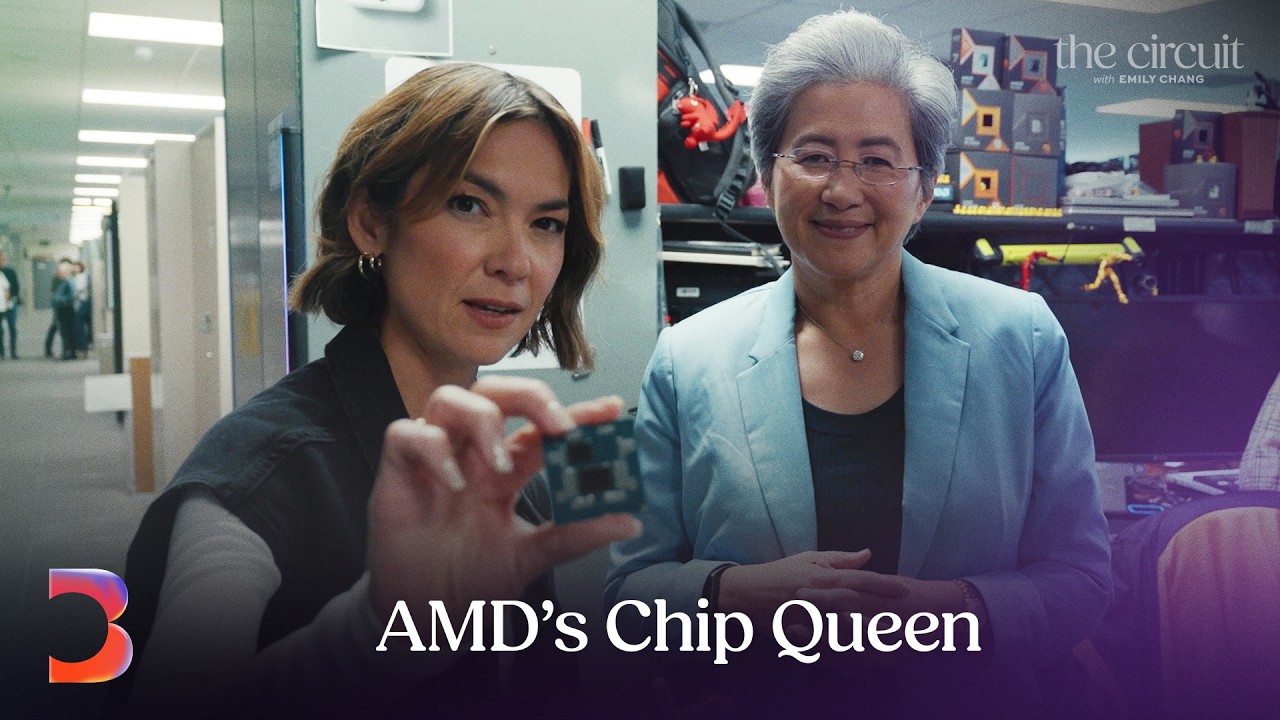
There's no shortage of drama when it comes to chip making.
談到晶片製造,戲劇性場面從不缺席。
00:04
Even when you're winning, the game changes.
就算你正處於領先地位,規則也可能隨時改變。
00:07
Do you ever feel like you're running a race that just never stops?
你是否曾感覺自己在一場永不停歇的競賽中奔跑?
00:11
Oh, of course.
喔,那是當然。
00:12
Of course, absolutely. That's exactly what we're doing.
當然,完全正確。這正是我們正在做的事。
00:15
I'm running like a different company every few years.
我每隔幾年就像在經營一家截然不同的公司。
00:17
Like, the industry is changing that fast.
整個產業的變化就是這麼快。
00:21
The technology that we're building is changing that fast.
我們所打造的技術也是如此。
00:23
It's a fantastic race, though, because each race is different.
不過,這是一場精彩的競賽,因為每場賽事都不同。
00:26
It's like a different movie, but it's a more exciting movie each time.
就像是一部全新的電影,而且每次都比上一次更刺激。
00:30
Today is a really big thing.
今天是個非常重要的日子。
00:31
Lisa Su, the CEO of Advanced Micro Devices, likes to be in the driver's seat.
超微(AMD)執行長蘇姿丰喜歡掌控主導權。
00:36
Born in Taiwan and raised in New York with a passion for electrical engineering and three degrees from MIT, Su worked at a couple of big-name chip makers before clinching a big victory, transforming AMD from a failing chip company into a formidable force in gaming PCs and the cloud.
她生於台灣、在紐約長大,對電機工程充滿熱情,擁有麻省理工學院的三個學位。在帶領 AMD 這家瀕臨失敗的晶片公司,蛻變為遊戲 PC 與雲端領域的強大力量之前,蘇姿丰曾在多家知名晶片製造商任職。
00:54
She's quick to remind us that her secret weapon is an obsession with the tech itself.
她總是不忘提醒我們,她的秘密武器在於對技術本身的癡迷。
00:58
Her no-nonsense approach probably helps, too.
她雷厲風行的行事風格可能也功不可沒。
01:02
I've heard you don't take a f*** from anyone.
我聽說你絕不對任何人妥協。
01:04
I was told you that.
有人是這麼告訴我的。
01:06
Seriously, I've heard your toughest nails, and I'm sure you have to be.
認真的,我聽說你是個狠角色,我相信你必須如此。
01:10
Well, I like to win.
嗯,我喜歡贏。
01:12
If that's okay.
如果這樣說沒冒犯到你的話。
01:14
I would tell people I was doing semiconductors, and they would say, What? Like, what's that?
我以前告訴別人我在做半導體,他們會說,什麼?像是,那是什麼?
01:19
Like, you build chips? Like, what does that mean?
像是你們在做晶片?那是什麼意思?
01:23
People don't even understand.
大家甚至都不懂。
01:24
Like, where technology really fit in the grand scheme of things?
像是,科技在整個大藍圖中到底佔據什麼位置?
01:28
Like, now, everybody knows.
像是,現在,所有人都知道了。
01:31
Like, everybody talks about chips.
像是,所有人都在談論晶片。
01:34
Chips roll just about everything around us.
晶片驅動著我們周遭的一切。
01:37
It's one of the most ubiquitous and consequential technologies in the world.
它是世界上最普遍且最具影響力的技術之一。
01:41
They power your smartphones, cars, planes, power grids, the Internet, the global economy, and even Formula One races, where AMD sponsors the Mercedes AMG Petronas team.
I think the adaptability that you need to have in this sport is similar to a high-performance, real-world company.
我認為在這項運動中你需要的適應能力,與一家高性能的真實世界公司很相似。
01:59
The technology develops, and that's why it's so much fun.
技術不斷發展,這也是它如此有趣的原因。
02:02
What I love is the stopwatch never lies.
我熱愛的是,碼表從不說謊。
02:05
Chips are at the heart of a global technology race, and a battle for supremacy between China and the United States.
晶片正處於全球科技競賽的核心,也是中國和美國之間爭奪主導權的戰役。
02:12
So, for the AMD CEO, the heat is on.
所以,對 AMD 的執行長來說,壓力來了。
02:14
She's in the middle of a race of her own, pulling off the impossible by surpassing our tribal intel, only to find that AI has completely changed the game, and now NVIDIA is in the lead.
她正處於自己的一場比賽中,超越我們的老對手 Intel,完成了不可能的任務,卻發現 AI 已經完全改變了遊戲規則,現在 NVIDIA 處於領先地位。
02:26
I'm in Austin to see how Sue competes on and off the track, and if she can pull off the unthinkable once again.
我來到奧斯汀,想看看蘇姿丰在賽道內外如何競爭,以及她是否能再次完成不可思議的任務。
02:45
Hello, hello.
你好,你好。
02:47
Thank you so much for doing this.
非常感謝你接受我們的採訪。
02:49
Oh, thank you. Thank you for coming.
喔,謝謝。謝謝你的到來。
02:50
So, the first thing we did when we got here is we went to your lab, and your engineers made us this chip.
所以,我們到這裡後做的第一件事,就是去了你的實驗室,你的工程師為我們製作了這顆晶片。
03:00
Wow.
哇。
03:02
It's our own chip.
這是我們自己的晶片。
03:04
A circuit on a circuit.
電路上的電路。
03:06
This is our epic with the circuit with Emily Trig.
這是我們與 Emily Trig 在電路上的史詩篇章。
03:09
You've been CEO of AMD for 10 years.
您擔任 AMD 執行長已 10 年。
03:11
You've been working in the chip industry for decades, but I want to go back to a moment.
您在晶片產業工作數十年,但我想回到某個時刻。
03:17
When did you first hear that you were going to be CEO of AMD?
您第一次聽說將擔任 AMD 執行長是什麼時候?
03:22
It's a phone call you get from your chairman of the board, and he said, Lisa, can you talk? I'm like, sure.
那是董事會主席打來的電話,他說:「Lisa,方便講話嗎?」我說:「當然。」
03:28
And he goes, it's time.
他接著說:「時候到了。」
03:31
And I'm like, time for what?
我說:「什麼時候到了?」
03:34
He said, you know, the board has made a decision, and they would like you to be the next CEO.
他說:「董事會已做出決定,他們希望您擔任下一任執行長。」
03:42
I said, okay.
我說:「好的。」
03:44
Well, how did that feel? Because it was a tough time.
嗯,當時感覺如何?因為那是個艱難的時期。
03:47
AMD was trading at $2 a share.
AMD 的股價每股只有 2 美元。
03:49
One guy said it was deader than dead.
有人說它比死還慘。
03:52
What made you think you could prove them wrong?
是什麼讓您認為自己能證明他們錯了?
03:54
The opportunity to be CEO of AMD, it was truly like a dream come true.
能擔任 AMD 執行長的機會,真的就像美夢成真。
03:58
It's like, wow, okay.
就像,哇,好的。
04:00
Like, you think that maybe you can do this?
想著,也許自己能做到這件事?
04:03
And you're going to have the opportunity to lead a major semiconductor company on, yes, you're right.
而您將有機會帶領一家大型半導體公司,是的,您說得對。
04:10
It wasn't the best time.
那並不是最好的時機。
04:12
But I was pretty confident that we had the right pieces.
但我非常有信心,我們已經掌握了正確的要素。
04:18
They just needed to be put together in the right way.
只需要以正確的方式將它們組合起來。
04:21
AMD was founded in 1969 by executives from Fairchild Semiconductor, the famed company that pioneered integrated circuits.
Founder Jerry Sanders was famous for saying, real men have fabs.
創辦人 Jerry Sanders 有句名言:真正的男人要有晶圓廠(fabs)。
04:34
Those are the plants that manufacture chips.
也就是製造晶片的工廠。
04:37
AMD started off as a memory chip maker like Intel and followed its larger rival into new markets, but always struggled to achieve the scale and performance Intel enjoyed.
With a cash crisis on its hands, AMD had to spin off those fabs and outsource its manufacturing.
面臨現金流危機,AMD 不得不剝離那些晶圓廠,並將製造業務外包。
04:53
A sign of the uphill battle Sue was facing, few believed AMD would make it, until she started making her moves.
這顯示了蘇姿丰(Sue)當時面臨的艱難處境,沒幾個人相信 AMD 能挺過去,直到她開始採取行動。
05:00
Now AMD stock is trading in a totally different stratosphere.
如今 AMD 的股價已處於完全不同的檔次。
05:05
Was there a moment along the way where you really saw AMD turn a corner?
在這個過程中,是否有某個時刻讓您真正看到 AMD 扭轉了局面?
05:10
Probably the most important moment for us was the launch of our new architecture.
對我們來說,最重要的時刻可能是我們發布新架構的時候。
05:17
The launch of Zen, you'll hear us talking about Zen a lot.
Zen 的發布,您會聽到我們經常提到 Zen。
05:20
Zen was our clean sheet design to really design the next generation architecture and in CPUs for the next decade.
Zen 是我們全新的設計,旨在為未來十年真正設計出下一代的 CPU 架構。
05:34
AMD's main competition in designing the best chips comes from two players, Nvidia in graphics processing units, or GPUs, and Intel in central processing units, or CPUs.
They run operating systems and programs, retrieve files, and are generally the heart of a computer.
它們運行作業系統和程式、擷取檔案,通常是電腦的心臟。
05:55
A GPU or graphics chip is much more specialized.
GPU 或圖形晶片則專業得多。
06:00
They were designed to do multiple small calculations simultaneously.
它們被設計來同時執行多個小型運算。
06:03
That parallel processing makes them ideal for AI.
這種平行運算使它們成為 AI 的理想選擇。
06:07
The new Zen architecture put AMD back on top and gave it a range of chips capable of taking market share from Intel.
新的 Zen 架構讓 AMD 重回巔峰,並賦予其一系列能夠從 Intel 手中奪取市佔率的晶片。
06:16
You proved the naysayers wrong.
你證明了那些看衰的人是錯的。
06:18
That has to feel like vindication.
這一定讓你感到揚眉吐氣。
06:20
Like, do you ever just like shut the door and go, yes, all by yourself?
比方說,你會不會偶爾關上門,對自己說:「是的,全靠我自己」?
06:27
I don't know that I do that, Emily.
艾蜜莉,我不確定我會這樣做。
06:31
Those first few years were more about just stabilizing the company and getting ourselves on a good road map, and then we went through a period of just tremendous growth around the portfolio, and now we're in the AI world.
剛開始的那幾年,更多是關於穩定公司並讓我們走上正軌,接著我們經歷了一段產品組合大幅成長的時期,而現在我們身處 AI 世界。
06:43
This current AI wave is moving so fast.
這波 AI 浪潮發展得非常迅速。
06:46
How would you describe the pace right now?
你會如何描述目前的發展速度?
06:48
I truly believe AI is the most transformational technology that I've seen in my career.
我真心相信 AI 是我職業生涯中見過最具變革性的技術。
06:54
And we've seen all kinds of technology transitions.
我們見證過各種技術轉型。
06:57
We've seen the rise of the internet.
我們見證了互聯網的崛起。
06:59
We've seen the rise of the PCs, mobile phones, cloud, all of these things were all really mega-trans.
我們見證了個人電腦、手機、雲端的崛起,所有這些都是巨大的轉型。
07:07
I think AI actually surpasses all of that.
我認為 AI 實際上超越了所有這些。
07:10
The rate and pace of change in the industry.
產業變革的速度和步伐。
07:14
It's like faster than anything we've ever seen.
它比我們見過的任何事物都要快。
07:16
It's like we've made more progress in the last 18 months than certainly the last 10 plus years.
就好像我們在過去 18 個月取得的進展,肯定比過去 10 多年還要多。
07:20
Now, to win and keep winning, you have to keep up the pace and keep bringing the heat over decades.
現在,要贏得勝利並持續獲勝,你必須保持步伐,並在數十年間持續展現實力。
07:26
How do you keep up your own pace, personally?
就個人而言,你如何保持自己的步調?
07:28
I really enjoy just the learning part of technology and the learning part of being in our industry.
我非常享受學習技術的過程,以及身處我們這個產業中學習的過程。
07:36
Like, I spend a lot of time with our engineers as they're developing products, and in every one of those conversations I learn something.
比方說,我花了很多時間與正在開發產品的工程師在一起,在每一次的對話中,我都能學到東西。
07:43
And I learn something that I can then say, hey, you know, maybe we should do this just a little bit differently.
於是我學到了一些東西,然後我可以說,嘿,你知道嗎,也許我們應該稍微調整一下做法。
07:53
I come here for two reasons.
我來這裡有兩個原因。
07:55
I come when there are good things, because I want to be able to see some of the new technology myself, and then I come when there's a problem.
當有好事發生時我會來,因為我想親自看看一些新技術;而當出現問題時,我也會來。
08:03
And when there's a problem, I'm here to cheer them up.
當出現問題時,我是來為他們加油打氣的。
08:06
Oh, yes!
喔,沒錯!
08:06
I'm here to cheer them up, not to crack the whip.
我是來為他們加油打氣的,不是來鞭策他們的。
08:08
No, because at the end of the day, like, these guys love what they do.
不是的,因為歸根結底,這些傢伙熱愛他們所做的工作。
08:11
I've heard you make some late night trips to the lab.
我聽說你曾深夜造訪實驗室。
08:14
I've done late nights. I've done weekends.
我也經歷過深夜加班,也經歷過週末工作。
08:17
I don't want to surprise them.
我不想讓他們感到驚訝。
08:18
It'd be too much for surprise. I can't just pop it in.
那樣太突然了,我不能就這樣突然出現。
08:21
You might have a heart attack.
他們可能會嚇得心臟病發作。
08:22
That's right.
沒錯。
08:23
I'm going to show you some of our latest tech.
我要向你們展示我們的一些最新技術。
08:27
This is a gaming chip.
這是一顆遊戲晶片。
08:28
We're pretty sure when it launches, it won't be the fastest gaming chip in the world.
我們相當確定,當它上市時,它不會是世界上最快的遊戲晶片。
08:32
What makes you think this is the fastest gaming chip in the world?
是什麼讓你認為這是世界上最快的遊戲晶片?
08:36
It has a special technology, which we call X3V, which puts, you know, memory really stacked on top of the processors.
它擁有一項特殊技術,我們稱之為 X3V,這項技術能將記憶體真正堆疊在處理器上方。
08:43
So it's phenomenal for gaming.
所以它對於遊戲來說表現驚人。
08:45
The fastest gaming chip in the world.
世界上最快的遊戲晶片。
08:47
Does it look like it?
看起來像嗎?
08:49
Who would know? She would.
誰會知道?她會知道。
08:52
We talked a lot about AI.
我們談了很多關於 AI 的事。
08:54
You need to at least see the technology.
你至少需要看看這項技術。
08:56
I don't want to see it.
我不想看。
08:56
So let's take a look here.
那我們就來看看這裡。
08:58
Bring it on.
放馬過來吧。
08:59
Yeah.
是的。
09:00
So what we have here is our...
所以我們在這裡有的是我們的...
09:03
These are our AI chips.
這些是我們的 AI 晶片。
09:04
This is MI300.
這是 MI300。
09:07
Engineering sample it says, and this is how it looks actually on the board.
上面寫著工程樣品,而這就是它實際在板子上的樣子。
09:11
I mean, the weight of AI.
我是說,AI 的重量。
09:15
So this is currently in production.
所以這目前正處於量產階段。
09:17
One of the things that we run is sort of a lot of the AI workloads, the stuff that's running on Microsoft Azure, you know, GPT, GPT-40, those things.
我們處理的其中一部分是大量的 AI 工作負載,那些在 Microsoft Azure 上運行的東西,你知道的,GPT、GPT-40 之類的。
09:28
They're running on MI300 Metas, llama.
它們在 MI300 上運行,像是 Metas、llama。
09:31
Did I hear that you refer to these machines as your children?
我聽說你把這些機器當作你的孩子?
09:36
They're all my kids.
它們都是我的孩子。
09:37
Yes.
是的。
09:37
So if you were to actually step into my library at home, you would see chips galore, because every time I launch a chip, like I save that as a souvenir.
In this new race to deliver the best chips for AI, Sue is focused on catching up to NVIDIA, a niche player that got its start in the 90s making chips for computer graphics and video games.
在這場為 AI 打造最佳晶片的新競賽中,蘇姿丰專注於追趕 NVIDIA。NVIDIA 是一家利基型廠商,在 90 年代以生產電腦圖形與電玩晶片起家。
10:10
NVIDIA realized early on that its GPUs could be pivotal for AI, and suddenly blew past its competitors when chat GPT came on the scene.
NVIDIA 很早就意識到其 GPU 對 AI 至關重要,當 ChatGPT 登場時,便一口氣超越所有競爭對手。
10:20
NVIDIA's chips are the hot commodity for meta, Google and Amazon, sending its stock through the roof and besting Apple as the most valuable company in the world.
NVIDIA 的晶片是 Meta、Google 和 Amazon 的熱門商品,推升其股價飆升,並超越 Apple 成為全球市值最高的公司。
10:31
NVIDIA is seen as the dominant force in AI right now.
NVIDIA 被視為目前 AI 領域的主導力量。
10:34
And AMD is widely considered the next best option.
而 AMD 則被廣泛認為是次佳選擇。
10:38
Is that good enough for you?
這對你來說就夠好了嗎?
10:39
Do you like being seen as the underdog?
你喜歡被視為黑馬嗎?
10:42
I wouldn't call it a like or dislike.
我不會用喜歡或不喜歡來形容。
10:45
What I would say is AMD has had a history of doing amazing things.
我想說的是,AMD 一直有做出驚人之舉的歷史。
10:51
And from that standpoint, we've always been in this place where we haven't necessarily had the same amount of people that other larger companies have, but we've certainly punched well above our weight in terms of technology capability, in terms of impact on the industry.
There's like more than enough chips for everybody to build.
每個人要開發的晶片都綽綽有餘。
11:54
And the beauty of this is everyone's recognized that chips are so important.
而美妙之處在於,大家都意識到晶片是如此重要。
12:01
Yes, so it's natural that they're going to have their own capability.
是的,所以他們要建立自己的能力是很自然的事。
12:04
Has the shake-up of a very established industry surprised even you?
這個非常成熟的產業發生動盪,是否連您都感到驚訝?
12:09
It has a little bit, I have to say.
我得說,確實有一點。
12:12
When you think about this conversation about the resiliency of the world, depending on, you know, semiconductor diversification, like those kinds of things, you know, those are big things.
當您思考關於世界韌性的討論,取決於半導體的多元化,諸如此類的事情,您知道,這些都是大事。
12:23
They're beyond an industry.
它們超越了單一產業。
12:25
They're really sort of underpinning sort of the global economy, you know, underpinning national security.
它們實際上是支撐全球經濟、支撐國家安全的基礎。
12:30
It is something that for someone who's been in semiconductors for a long time, it's different.
對於在半導體領域深耕多年的人來說,這是很不一樣的。
12:36
This is a very complex business with trillions of moving parts.
這是一個非常複雜的行業,有數兆個環節。
12:40
One wrong bet or manufacturing delay can cost billions and give competitors the chance to jump ahead.
一次錯誤的押注或製造延誤,就可能造成數十億美元的損失,並給競爭對手超越的機會。
12:46
Just ask Intel.
問問英特爾就知道了。
12:48
It's just been a stunning fall from Greece.
它的衰落簡直令人震驚。
12:51
This company used to be the world's dominant chip maker.
這家公司曾是全球主導的晶片製造商。
12:54
Over the years, they have fallen away from being the leader.
這些年來,他們已失去領導地位。
12:57
Their technology is not advanced.
他們的技術並不先進。
12:59
We saw the worst share decline in about 40 years for the company.
我們看到該公司遭遇約 40 年來最嚴重的股價下跌。
13:02
They gave a very grim growth forecast.
他們給出了非常悲觀的成長預測。
13:05
They also made or announced plans to slash 15,000 jobs.
他們也制定或宣布了裁員 15,000 人的計畫。
13:09
They've always been on the brink and they always seem to find a way, but we've never seen anything like this.
他們一直處於懸崖邊緣,也總能找到出路,但我們從未見過像這樣的情況。
13:13
Back in San Francisco, I wanted to get perspective on the changing dynamics of the chip industry from Bloomberg reporter Ian King.
回到舊金山,我想聽聽彭博社記者 Ian King 對晶片產業變局的看法。
13:19
Who knows the stakes better than anyone else?
誰比他更了解其中的利害關係?
13:23
Explain the pace of the chip industry.
請解釋晶片產業的發展速度。
13:26
Does it feel like a race to you?
這對你來說像是一場競賽嗎?
13:28
It's absolutely a race.
這絕對是一場競賽。
13:30
It's a murderous race.
這是一場殊死戰。
13:31
You fall behind.
一旦落後。
13:32
You are in big trouble.
就會陷入大麻煩。
13:33
So decades, Intel had more resources than anybody else, more revenue, and was way ahead.
數十年來,英特爾的資源比任何人都多,營收更高,並且遙遙領先。
13:38
It set the agenda.
它主導了產業議程。
13:40
Takes five years off, basically made some bad decisions that it shouldn't have made.
它浪費了五年時間,基本上做了一些不該做的錯誤決策。
13:44
And now we're in a position where they might never catch up again, right?
現在我們面臨的情況是,他們可能永遠無法再次追上,對吧?
13:47
The train does not wait for anybody.
火車不等任何人。
13:50
What do you think Lisa's legacy will be?
你認為莉莎(Lisa)的 legacy 會是什麼?
13:51
It's already cast in stone, right?
這不是已經塵埃落定了嗎?
13:54
They're going to build a statue of her because she took a company that was and also ran that used to get laughed at, almost made a difference, right, AMD, and made it a significant provider of cutting-edge technology, a serious company, one that people believe in and trusted.
Are we trading the dominance of one company for another?
我們是否正在用一家公司的主導地位換取另一家?
14:14
The direction for the industry was set by Intel for decades.
數十年來,這個產業的方向都是由英特爾(Intel)制定的。
14:17
Right now, the whole AI thing is built on Nvidia.
現在,整個 AI 領域都是建立在輝達(Nvidia)的基礎上。
14:21
Nvidia is coming out with software, new chips, new services, faster than anybody else's, and everybody's just following them because that's the easy thing to do.
輝達推出軟體、新晶片、新服務的速度比任何人都快,而所有人都只能跟在後面,因為這是比較容易的做法。
14:28
At a certain point, they become utterly pervasive and then the cost of replacing them becomes difficult.
到了某個時間點,它們會變得無所不在,到時候要取代它們的成本就會變得很困難。
14:34
So what does AMD have to do to catch up?
所以 AMD 要做什麼才能追上?
14:37
Depends what you mean by catch up, right?
這要看你所謂的「追上」是什麼意思,對吧?
14:39
This industry tends to have a very strong player, number one in each market, good number two, and then a number three where you're like, why are you bothering?
At the moment, AMD is a solid number two and doing well.
目前,AMD 是穩固的第二名,而且表現不錯。
14:51
They have billions of dollars of revenue from this AI accelerator that they didn't have last year.
他們從 AI 加速器上賺進了數十億美元的營收,這是他們去年沒有的。
14:56
So they're doing way better, but compared to the tens of billions of dollars that Jensen's bringing in at Nvidia are a long way behind.
所以他們的表現好很多了,但與黃仁勳(Jensen)在輝達賺進的數百億美元相比,還是落後一大截。
15:03
Let's talk a little bit about the geography.
我們來談談地理分佈。
15:05
How did the chip industry become so concentrated in Taiwan?
晶片產業是怎麼變得如此集中在台灣的?
15:08
The industry is concentrated in South Korea, in memory, in Taiwan with logic manufacturing.
這個產業在記憶體方面集中在韓國,在邏輯製造方面集中在台灣。
15:15
Intel used to sneer at them and say, outsource manufacturing and semiconductors doesn't make sense.
英特爾過去曾嘲笑他們,說外包半導體製造沒有意義。
15:20
It's not practical, it'll never be as good as we are.
這不切實際,永遠不可能做得跟我們一樣好。
15:23
Guess what? It's way better than they are right now.
猜猜怎麼著?現在它們的表現遠比他們好得多。
15:26
It's enabled Nvidia, it's enabled AMD and a host of other companies that could never compete with Intel to do more than compete to win because it's providing the best manufacturing in the world.
The US government is considering capping exports of your chips and in videos to other countries.
美國政府正考慮限制晶片及相關技術對其他國家的出口。
16:57
Is that the right call?
這是正確的決定嗎?
16:59
The technology that we're building is some of the most powerful chips in the world.
我們正在開發的技術,是世界上最強大的晶片之一。
17:03
And so we totally get that there's a national security element of it.
因此我們完全理解其中涉及國家安全的因素。
17:06
We want there to be as open a market as possible, while still taking into account the national security interests.
我們希望市場盡可能開放,同時兼顧國家安全利益。
17:13
And it's a given take.
這需要互相妥協。
17:14
Do you worry about the future of Taiwan?
您擔心台灣的未來嗎?
17:16
We all worry about ensuring that there is resiliency in the supply chain.
我們都擔心確保供應鏈的韌性。
17:21
So put China and Taiwan aside.
所以先把中國和台灣放在一邊。
17:23
Years ago, we had a big storm in Texas, and things were out for a few days.
幾年前,德州曾遭遇一場大風暴,導致供應中斷了幾天。
17:29
That's geographic concentration that you want to make sure that there's resiliency for.
這就是地理過於集中的風險,你必須確保供應鏈具備韌性。
17:34
You were born in Taiwan, and I know you go back to your hometown often.
您出生在台灣,我知道您經常返鄉。
17:37
What's your favorite thing to do when you're not visiting fabs?
除了參訪晶圓廠,您最喜歡做什麼?
17:41
You know, I really do love Taiwan.
您知道嗎,我真的很愛台灣。
17:44
And I was born in Taiwan, so it was a small city in the southern part of Taiwan.
我出生在台灣南部的一個小城市。
17:50
Actually, I was just there not too long ago to visit family, and we have a big family.
其實不久前我才回去探親,我的家族很大。
17:55
Like, you know, my dad had like nine siblings, and my mom had like six, so it was like a big family.
比如,我爸有九個兄弟姊妹,我妈有六個,所以是個大家族。
18:01
So there are lots and lots of cousins and aunts and uncles and all of that.
所以有非常多的表兄弟姊妹、阿姨、叔叔等等。
18:05
And so, yeah, it's just fun to kind of be a part of that.
能成為其中的一份子真的很有趣。
18:07
Everyone's curious about the habits of super successful leaders.
每個人都對超級成功領袖的習慣感到好奇。
18:11
What are your go-tos? Like what's in your daily routine?
您的必備習慣是什麼?您的日常作息是怎樣的?
18:13
Well, this morning I was up at 6.30 boxing, so that's in the daily routine.
嗯,今天早上我六點半就起床去打拳擊了,這是日常的一部分。
18:20
You need to have energy when you start a morning?
開始新的一天時,你需要有充沛的精力嗎?
18:22
Heck yeah.
當然需要。
18:24
And, you know, a day is either, you know, here in the office or it's on the road.
而且,你知道,一天要麼在辦公室度過,要麼就是在出差的路上。
18:29
But what I'm hearing, Austin, it's a good day.
但我聽你說,Austin,這是很棒的一天。
18:32
When the pace is relentless and perfect execution is the only option, sometimes you need to take your foot off the gas and watch another team compete for some inspiration.
當節奏緊湊且完美執行是唯一選擇時,有時你需要放慢腳步,看看另一支隊伍的比賽來尋找靈感。
18:42
Formula One is the most technologically advanced motorsport in the world, and AMD's chips give the Mercedes F1 team an edge in the competition.
一級方程式賽車是世界上技術最先進的賽車運動,而 AMD 的晶片讓梅賽德斯 F1 車隊在比賽中佔據優勢。
18:50
Two is giving us a front-row seat to the action because, well, she likes fast cars too.
Two 也讓我們能近距離觀賞賽事,因為,嗯,她也喜歡跑車。
18:55
We have a lot of portions in our family.
我們家裡有很多成員。
18:58
That's our thing.
這是我們的風格。
18:59
One of the things is all of my cars have like our product names on it, so I have a Ryzen and I have an Epic and I have a Radeon and I have like an Epic two.
The Epic color is graphite blue metallic and it's a gorgeous color.
Epic 的配色是石墨藍金屬色,這是一種非常漂亮的顏色。
19:20
And that's the color of your Porsche.
這也是你保時捷的顏色。
19:22
It is.
沒錯。
19:23
That's epic.
真是太 epic(強大)了。
19:24
When you look at a car and have one car, does it look like a computer on wheels to you?
當你看著一輛車,尤其是當你擁有一輛車時,它對你來說像是一台輪子上的電腦嗎?
19:28
It absolutely does.
絕對是的。
19:29
It's actually even more than that.
實際上甚至不只如此。
19:31
I mean, the car itself is just one piece of the equation, right?
我的意思是,賽車本身只是整個方程式的一部分,對吧?
19:34
What's so amazing about the entire Formula One technologies, it's the car, but then it's also just everything behind it that helps get the car ready.
一級方程式技術最驚人的地方在於,除了賽車本身,還有幕後協助讓賽車準備就緒的一切。
19:45
I mean, it's filled with chips and sensors.
我是說,車上充滿了晶片和感測器。
19:46
I love the fact that, you know, Toto actually keeps us informed about how things are going.
我很喜歡 Toto 實際上會讓我們隨時了解進度這一點。
19:51
And, you know, it's great that our technology helps them make some of those adjustments.
而且,我們的技術能協助他們做出調整,這真的很棒。
19:55
At Formula One, along with Star Driver Louis Hamilton, Mercedes Racing Boss Toto Wolf is an institution.
在一級方程式賽車界,除了明星車手路易斯·漢米爾頓,賓士車隊老闆 Toto Wolf 也是一大傳奇人物。
20:02
He works hand in hand with companies like AMD and a team of elite engineers to push the limits of speed and performance for their cars.
他與 AMD 等公司以及一群頂尖工程師團隊緊密合作,為他們的賽車突破速度與性能的極限。
20:08
There's a million different things that go into winning.
贏得勝利涉及無數個不同的因素。
20:11
How do you figure out the one thing that nobody else knows?
你要如何找出那個只有你知道的關鍵?
20:13
There is no such thing as one thing.
根本不存在所謂的「單一關鍵」。
20:16
I agree with you.
我同意你的看法。
20:17
It's true.
確實如此。
20:18
Chip industry or motor racing is just good engineering.
晶片產業或賽車運動,靠的都是優良的工程技術。
20:22
Empowerment of people, development of people, and giving them the tools to come up with good ideas and make them reality.
賦予員工權力、培養人才,並提供他們工具來提出好點子並付諸實現。
20:31
Speaking of the technology, how do you think AI is going to change racing?
說到技術,你認為 AI 將如何改變賽車?
20:34
Engineers would always say the weakness of the car sits between the steering wheel and the engine.
工程師總會說,賽車的弱點在於方向盤和引擎之間。
20:41
Because it's irrational.
因為那是非理性的。
20:43
It has good and bad days.
人有心情好壞的時候。
20:45
This human interaction is difficult to replicate.
這種人與人之間的互動很難複製。
20:49
Because it's an infinite amount of data we generate.
因為我們產生的數據量是無窮的。
20:52
The driver has so many sensors.
賽車手有許多感測器。
20:54
We have hundreds of millions, if not billions of sensors in our body, that make the individual still much superior to the machine and the racing car.
我們人體內有數億甚至數十億個感測器,這使得人類仍然比機器和賽車更優越。
21:01
So we are in our infant shoes in terms of AI and application from everyone.
所以在每個人的應用和人工智慧方面,我們都還處於起步階段。
21:09
Louis, how are you? It's so great to see you.
Louis,你好嗎?很高興見到你。
21:11
Let me see you.
讓我看看你。
21:12
What's your vibe today? What do you think? How are you feeling?
你今天狀態如何?你怎麼想?你感覺怎麼樣?
21:15
Practice one was throwing this.
第一次練習簡直是一場災難。
21:17
It's like the worst practice. I had a big spin.
這是我經歷過最糟糕的練習,我發生了一次嚴重的打滑。
21:20
This is a circuit with all the high speed. It's all about confidence.
這是一條高速賽道,一切都取決於信心。
21:22
You have to get building blocks.
你需要打好基礎。
21:24
So when you have a spin like that, it knocks you down.
所以當你像那樣打滑時,會打擊你的信心。
21:26
You don't have a lot of time to get back there.
你沒有太多時間重新振作。
21:29
So in this session, I just have to go for it.
所以在這次練習中,我只能全力以赴。
21:31
I hope that the car is there.
我希望車子能配合。
21:33
And you're so involved on the engineering side of things.
而且你非常深入參與工程方面的事務。
21:35
What drives you to do that?
是什麼驅使你這麼做?
21:37
That's the fun part.
這就是樂趣所在。
21:38
So that's why you happen to have creativity.
所以這就是為什麼你剛好具備創造力。
21:40
I'm not a designer in terms of the car, but I love trying to understand it.
我雖然不是汽車設計師,但我很喜歡嘗試去理解它。
21:45
And trying to see if I can pull something out of the design means that they have already done.
試著從設計中看出端倪,意味著他們已經完成了某些工作。
21:48
By the way, Louis is a gamer too.
順帶一提,Louis 也是個遊戲玩家。
21:50
Oh, really?
喔,真的嗎?
21:50
So he is a similar to our gaming technology.
所以他跟我們的遊戲技術有些相似。
21:51
I only ever play Call of Duty.
我只玩過《決勝時刻》。
21:55
I've been looking recently.
我最近一直在看。
21:56
Like, what else is that? I know there's a lot that I'm missing.
還有哪些遊戲?我知道我錯過了很多。
21:59
The thing that there's such a nice parallel with Formula One is we learn in every race.
這跟一級方程式賽車有個很好的相似之處,就是我們在每場比賽中學習。
22:03
It's the same thing in our world in technology, right?
在我們的科技領域也是如此,對吧?
22:06
We learn with every customer environment that we put our technology in, with the entire, you know, F1 season.
我們在每個客戶環境中部署技術時都會學習,就像整個 F1 賽季一樣。
22:12
Like every race you learn something and you adjust.
每場比賽你都會學到東西並進行調整。
22:16
While it's still early days in the next great technology race, Sue has shown she can master a pivot and deliver results, something none of her predecessors could at a company that many had written off.
And typical of Sue, she skips the victory lap and is laser focused on the next step forward.
這是蘇姿丰的典型作風,她跳過了勝利巡遊,專注於邁向下一步。
22:32
What else do you want to accomplish in the world, aside from making AMD succeed?
除了讓 AMD 成功之外,你還想在世界上完成什麼?
22:36
I'm passionate about the next generation of leadership.
我對下一代的領導力充滿熱情。
22:39
So I, you know, I was very lucky in my career.
所以,你知道,我在職業生涯中非常幸運。
22:43
People paid attention and, you know, gave me opportunities.
人們關注到了我,並給了我機會。
22:46
I believe that's part of my job as well.
我相信這也是我工作的一部分。
22:48
There should be more women in technology.
科技界應該有更多的女性。
22:50
I think there are more.
我認為還有更多。
22:52
Like we've made a lot of progress over the last number of years, but there's a lot more to do.
雖然我們在過去幾年取得了很大的進展,但還有更多事情要做。
22:57
So what's the lesson in there?
那麼,從中學到的教訓是什麼?
22:58
Have confidence in yourself, right?
就是要對自己有信心,對吧?
23:00
Take a chance.
要勇於嘗試。
23:01
Like don't worry about failure.
不要擔心失敗。
23:03
Like sit in those meeting rooms and say what's on your mind and volunteer.
坐在那些會議室裡,說出你心中的想法,並主動爭取機會。
23:09
I was given this advice when I was a young engineer.
當我還是個年輕的工程師時,就有人給過我這個建議。
23:11
It was, you know, run towards problems.
那就是,你要知道,主動迎向問題。
23:15
And what does that mean?
這是什麼意思呢?
23:16
It means, look, we're all going to work really hard every day.
意思是,你看,我們每天都很努力地工作。
23:19
You might as well work really hard on something that is really important.
與其如此,不如努力去做真正重要的事。
23:23
And so look for that hardest problem to solve and volunteer to help because you're going to learn a lot in the process.
所以,去尋找最難解決的問題,並主動提供協助,因為在這個過程中你會學到很多。
23:31
You're going to distinguish yourself.
你會讓自己脫穎而出。
23:32
And what's the worst thing that's going to happen?
最壞的情況會是什麼?
23:34
Like you make a mistake.
就是你犯了錯。
23:35
Okay, fine.
好,沒關係。
23:36
Get up.
站起來。
23:37
The next day is another day and you will have learned so much in that process.
明天又是新的一天,而你在那個過程中已經學到了很多。
23:53
MUSIC
音樂
AMD's CEO Wants to Chip Away at Nvidia's Lead | The Circuit with Emily Chang
0 人收藏
為這單元評分:
-分|0人評分
📝 影片摘要
本單元深入探討了半導體產業的快速變遷與激烈競爭,聚焦於 AMD執行長蘇姿丰如何帶領公司從谷底翻身,成為遊戲PC與雲端領域的領導者。影片闡述了晶片技術的關鍵地位及其對全球經濟和地緣政治的影響,特別是在 AI 發展浪潮下,AMD 如何應對 NVIDIA 的領先地位,並積極佈局 AI 加速器市場。內容還涵蓋了蘇姿丰的領導哲學、對技術的熱情、以及半導體產業的全球佈局和供應鏈韌性等議題,並藉由 F1 賽車的類比,說明高速競爭下的策略與工程的重要性。